
Harajuku Station is old and extremely outdated, but still fun to be around.
Sunday is the only day of rest for a significant amount of people in Japan. Therefore, I planned to visit all the locations where I wouldn't mind such big crowds. I wanted to visit Harajuku, which Gwen Stefani has made famous over here in America by promoting their style and even starting a clothing brand. I read that Sundays were the best days to go because that's when all of the young people dress up in the Harajuku style and hang around the neighborhood. Specifically, I heard that Jingū-Bashi (Jingū Bridge) is where they like to congregate for gawkers and photographers.
Well, I must have either been too early, or the bridge is just not a "cool" spot anymore because I didn't see any boys or girls there with eccentric Harajuku style.

Jingū-Bashi is where all of the cool kids are supposed to be hanging out on Sundays. However, I saw none.

With that, I started walking towards Meiji Shrine, which is on the west side of Harajuku Station.

Barrels of sake called nihonshu are donated to the Meiji Shrine every year to the enshrined deities.

As with all shrines, there were plenty of big torii gates to see.

The water basin at Meiji Shrine for temizu, the hand washing custom before going into the shrine. Yes, I washed my hands here out of respect for the shrine, but I didn't drink it and rub it all over my face like I saw most people doing.

Meiji Shrine.

I was lucky enough to catch the start of a wedding ceremony while at Meiji Shrine. It was all serious and proper. The only one smiling was pretty much the bride.

Ema at Meiji Shrine.

A lantern hanging up at Meiji Shrine.

Some dude shaking out a stick to pick his fortune for o-mikuji. Every time I passed by these, I was tempted to do it, but then I thought I'd rather spend the 100 yen on trying a new drink instead.

Oh yeah, that's more like it!

After Meiji Shrine, I went east of Harajuku Station to check out the more fashion focused part of the city. Here is a cool abstract mirror entrance/exit to Tokyu Plaza.

Chain stores are mixed in with one off clothing shops all over Harajuku. Both have cute Japanese girls out front yelling in high-pitched anime voices to go into their store.

There was a super neat Evangelion Store in Harajuku, just off of the main path. I was never a huge fan myself, but a store purely dedicated to one anime series is just cool.

There are two crepe places along Takeshita Street that are right across from each other. Both almost always have long queues.

This street is absolutely nuts on a Sunday. I loved it.

I went backwards up Takeshita Street, I guess, but at least I managed to get through it alive.

You do still end up seeing plenty of people in aberrant styles. Some pretty crazy fashion sense at times, but that's the way these folks choose to express themselves.

It was time to head to my next location, Shibuya. Thankfully, it was only one train stop away.

Taken while riding the Yamanote Line train. This line just goes in a big circle around Tokyo and hits a lot of the major stops.

Get off of the Yamanote Line at Shibuya Station, and this is what you might see. The Shibuya Crossing is world famous, as well as the world's busiest intersection. All street traffic stops at one point to allow for pedestrians to scramble every which way for their destination. It is the most organized piece of mess that you will ever see.

This shot of Shibuya Crossing is from the other side at the Starbucks. Unless you buy coffee or food there, they don't really take too kindly to you taking pictures from there. I was asked to stop taking pictures by a waitress there, but I had gotten a lot of shots already, so it was worth it.

A walk around Udagawa-cho will have you finding a ton of stores and restaurants. Shibuya apparently also has a fairly active nightlife, but I did not partake in any of that.

I somehow ran into the Animate store in Shibuya and checked out all of their anime goodies. Finally found something to buy here.

I had lunch in Shibuya at a popular restaurant called Kamukura. Lots of restaurants have vending machine outside or just inside the door where you purchase tickets for what you want to eat and drink. Super convenient for non-Japanese speaking customers like me who can just look at the pictures. Some places might not have pictures, so usually picking the first few options will get you the restaurant's most popular dishes.

This was what I ordered. The gyoza was great, but the ramen was so-so. I ordered their most popular ramen bowl, but it had too much cabbage in it for my tastes. Still, it was better than anything you could get around Seattle.

It was time for me to try out the diagonal pedestrian crossing at Shibuya Crossing. I made it across safely, but zigzagging all around people was a crazy experience. Scarlett Johansson made it look so easy in Lost in Translation.

It was time to visit Hachikō. The bronze statue of the famous dog is a popular meeting spot in Shibuya. You've probably heard of the story of Hachikō before, either through Futurama, or that Richard Gere movie from 2009 called Hachi: A Dog's Tale. Hachikō would greet his owner everyday around Shibuya Station precisely when his train arrived. After the owner dies, Hachikō continued to try to meet his master there every single day for nine years. In Japan, he is known as "chūken Hachikō," which means faithful dog Hachikō.

Underneath the Shibuya Crossing is a huge upscale food market known as Tokyu Food Show. You can find many delicacies here ranging from fresh seafood to gourmet chocolates. Here are some cantaloupe, which have been very well taken care of from birth. They are supposed to be perfect in shape, taste, color, and in every other single way. The price tag on the two melons with the red ribbons on them is 21,000 yen. That's about $205 here in the U.S. Would you pay that much for a perfect cantaloupe.

After spending a good amount of time in Shibuya, it was time to head northeast to Asakusa. This was an area I had planned on visiting yesterday, but the rain ruined it for me. I first went to Sensō-ji Temple, which is probably the most popular temple attraction in Tokyo. This is the entrance.

For some reason, I always thought rickshaws were a Chinese invention, but I guess they originated in Japan. There were a lot around Sensō-ji Temple, as well as in Kyoto when I visited there (look forward to that in Day 5).

The alley leading up to Sensō-ji is gorgeous and filled with tons of souvenir shops and snack stalls. I bought a few things in this area for gifts.

And here is Sensō-ji Temple. There was a long line to get up to the front of the temple, but you can't take pictures from up there anyway, so I never went up.

There's this area where you can breathe in incense and waft the smoke over your body as an act of purification.

After the temple, I walked east towards Sumida River. Right across the river is the Tokyo Skytree, which is the second tallest structure in the whole wide world. More on that later. Also across the river is the Asahi Building, which has the golden flame on it. It originally sat vertically on top of the building and people thought it looked like a golden poo. I believe the Tokyo government asked them to change the position of the flame and now people call it the golden sperm.

Saw these young ladies dressed up in kimono walking along the path in Sumida Park. Spotting folks in kimono was almost a daily thing, but it's still not very common.

Sumida Park is a popular spot for hanami, but all of the traditional cherry blossom trees were empty by the time I got there. There were the late season blooming sakura trees there though.

This futuristic-looking boat is called the Himiko. It was designed by Leiji Matsumoto who is the man responsible for some galactic anime titles such as Yamato, Galaxy Express 999, and Herlock. I had planned to go on this boat if I had spare time, but I did not get the chance to.

As it was starting to get dark, I made my way to the Yurikamome Line, which takes you to the man-made Tokyo island of Odaiba. Here is a bullet train crossing over a bridge from the first station.

The Yurikamome is an automated and elevated train which offers some fantastic views of the city. Especially when you cross Rainbow Bridge.

This is the Fuji Television studios building in Odaiba. It's a neat looking building.

Odaiba is home to a small replica of the Statue of Liberty. Other than that, and a view of Tokyo city, the artificial island is pretty much a leisure island. I found it to be a great place for families and those who like to shop.
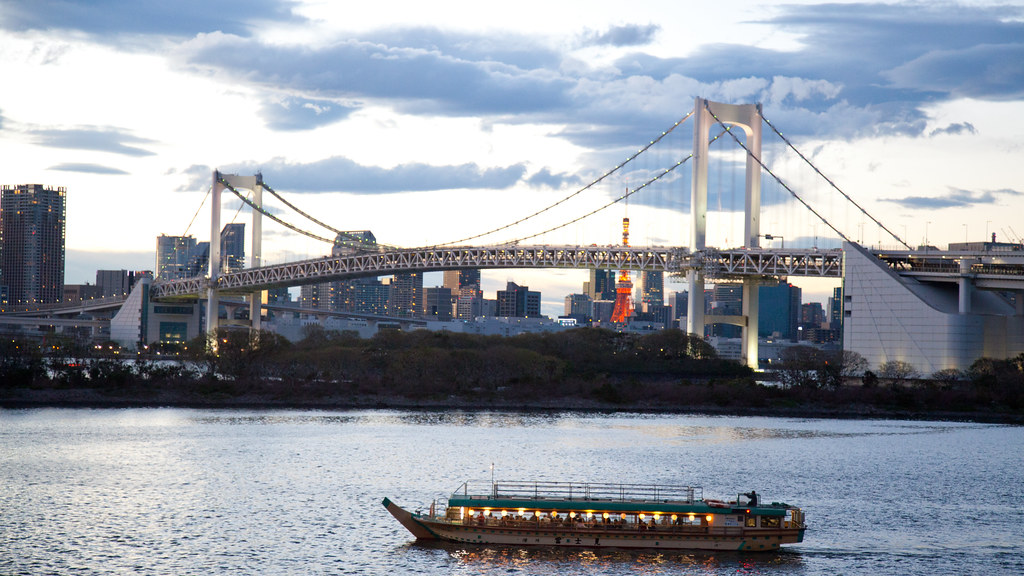
Rainbow Bridge from Odaiba. After dusk on some nights, they light up the bridge in all sorts of wonderful colors. Hence the name.

There was a pretty lit up tree in front of the Fuji TV building. Felt like Christmas.

Walk over to the shopping center known as Diver City and this is what you can see. A full scale RX-78-2 Gundam suit.

During certain times throughout the day, the Gundam’s head moves and sprays jets of mist with a light show displayed from 50 different places on the Gundam's body. I got to see this while eating dinner in the food court. Didn't get my camera out in time for that.

There is a Gundam Cafe right by the model Gundam that fans can go to. I was never the biggest Gundam Wing watcher, so I didn't bother. On the other hand, if there was a Sailor Moon Cafe...

The Diver City mall itself was quite large with tons of stores and a nice food court. I got more gifts here, too.

I had chicken yakisoba at the food court there. It was muy deliciouso.

After dinner, I walked over to Venus Fort/Palette Town, but I did not go inside as it was getting late and my feet were getting tired. They have a colorful ferris wheel there, which provides beautiful views of Tokyo. However, ferris wheels are either a family or couples thing in Japan, so I opted to skip this.

The walkway from Venus Fort to Odaibakaihinkoen Station is kind of futuristic looking.

The other end of the walkway has colorful arches that offer some neat photo ops.

I walked all the way to Odaiba Beach to set up my tripod in the sand and take some long exposure shots of Rainbow Bridge and the city. Odaiba, along with Minato Mirai 21 in Yokohama, are two of the only places in the Greater Tokyo Metropolitan area where the seashore is accessible. Most areas next to the water are blocked by industry and harbor areas. Unfortunately, my tripod snapped when I was adjusting it at one point rendering it useless. The above shot is the only picture I got out of it.
I knew I needed to get my sleep that night, because the next day I would be hopping on my first ever bullet train ride to Kyoto. Next time: Day 5 - Kyoto!
See all 193 photos from Day 4 of my Japan 2013 trip here. See all 28 mobile uploads from Day 4 here.
Day 1 is here.
Day 2 is here.
Day 3 is here.
No comments:
Post a Comment